

Franchise SEO is the work of getting your brand found nationally and getting each location found in its own city. The key is a system: one shared structure, one page and one Google Business Profile per location, and reporting that shows each branch on its own.
That is harder than single-location SEO. You have many owners, many pages and many local rivals, all under one brand. This guide shows you how to set it up, who does what, and what to measure. It is written for franchise brands and multi-location owners in places like Las Vegas, Henderson, Southern California and Northern Arizona.
TL;DR
- Give every location its own page and its own Google Business Profile, and link the two together.
- Keep brand content in one place. Make each location page different in ways that matter to local customers.
- Split the work: the franchisor owns the site, data and reporting. Each location owns reviews and local content.
- Judge each location by calls, form fills and booked jobs, not by one rank screenshot.
- A strong national brand does not win every city. Local relevance, distance and prominence decide the map results.
Table of Contents
- What franchise SEO is, and how it differs from single-location SEO
- How Google ranks each location
- Build a site structure that avoids self-competition
- Set up Google Business Profiles for every location
- Choose local keywords and write content that helps
- Manage citations, reviews and links across locations
- Who does what: franchisor and franchisee
- What to measure for each location
- A simple rollout plan
- Where MCNM fits
- Our view on franchise SEO
- FAQ
- Next step
- Sources
What franchise SEO is, and how it differs from single-location SEO
A single-location business optimizes one website and one Google Business Profile for one market. A franchise does that work again for every branch, while also protecting one brand.
So you run two jobs at once:
- Brand visibility. People search your brand name or your service in general. Your main site needs to win those searches.
- Local visibility. Someone in Henderson searches “[service] near me.” The Henderson location needs to show up, not the brand’s headquarters in another state.
Three problems come with that scale:
- Duplicate content. Fifty pages with the same text and a different city name compete with each other.
- Location overlap. Two branches in the same metro area can fight for the same searches.
- Blurred data. Sitewide totals hide a branch that is losing ground.
Every section below solves one of these.
How Google ranks each location
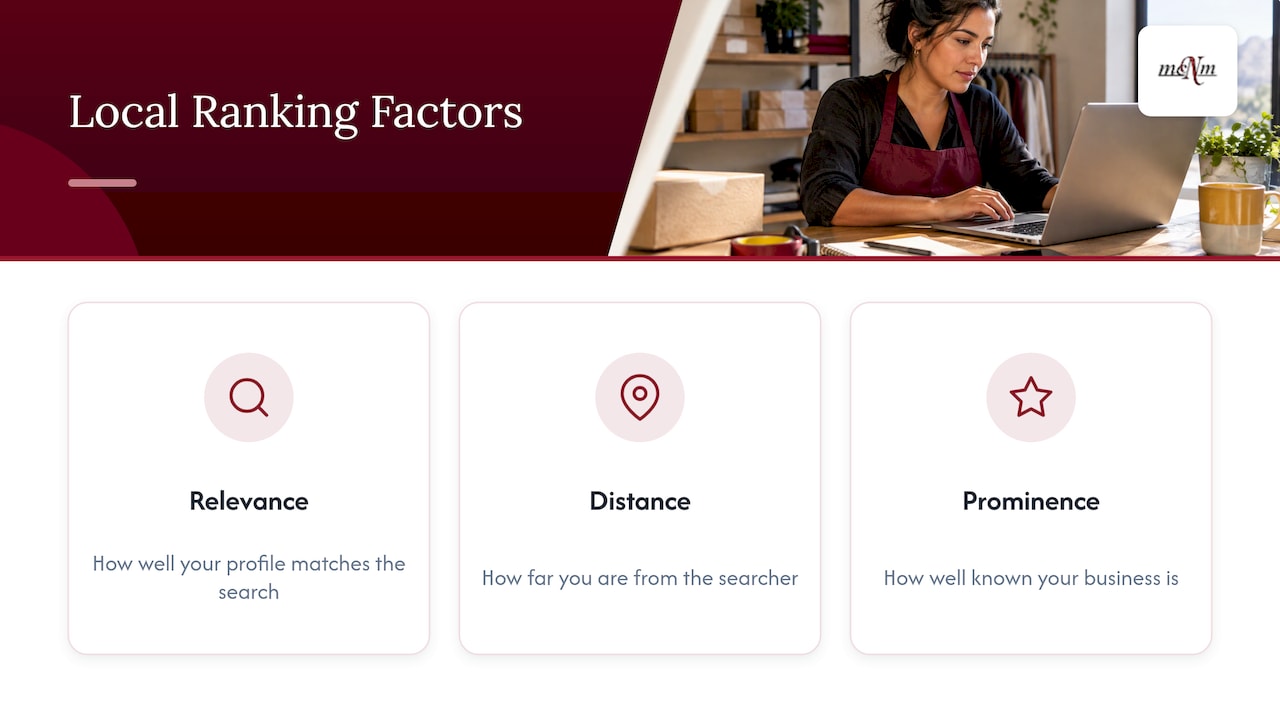
Before you build anything, know how local results work. Google says local results are mainly based on relevance, distance and prominence. Relevance is how well your profile matches the search. Distance is how far you are from the searcher. Prominence is how well known your business is.
There is one more line in Google’s guidance worth reading twice: you cannot request or pay for a better local ranking.
For a franchise, this has a clear meaning. Brand strength helps with prominence. It does not change distance, and it does not fix a thin profile. A well-run independent shop in Summerlin can still beat your branch in a Las Vegas search if its profile and reviews are stronger. Each location has to earn its place.
Build a site structure that avoids self-competition
The most common franchise mistake is cloning one page across dozens of URLs. The fix is a clear split between what lives centrally and what lives locally.
Keep brand content central
Put broad brand, educational and evergreen content in one place. Search Engine Land’s March 2026 analysis on multi-location SEO recommends centralizing that content rather than repeating it across many location URLs. Your “how to choose a service” guide, your brand story and your service explainers belong on the main site once.
Make every location page distinct
The same analysis recommends making local pages distinct with market-specific copy, metadata, FAQs, service variations, testimonials, team details, community ties and local images. Here is what that looks like in practice.
| Element | Weak version | Strong version |
|---|---|---|
| Title and headings | “Our Services” with a city swapped in | The main service plus the city or neighborhood |
| Contact details | Corporate phone number | The branch’s own address, hours and local phone number |
| Proof | Brand-wide reviews | Reviews and photos from that location |
| Copy | Same paragraphs on every page | Local detail: neighborhoods served, local questions, the team |
| Map | None | Embedded map and directions |
Give each page one main target: a service plus a city or neighborhood. That keeps two branches from chasing the same phrase. If two locations serve overlapping areas, split the targets by neighborhood or by service so each page has its own lane.
A Flagstaff, Sedona and Prescott brand is a good example. Each town has different visitors, different seasons and different questions. A page for Sedona can speak to tourists planning ahead. A page for Prescott can speak to year-round residents. Do not swap the town name and publish.
For a deeper build guide, read our article on location page SEO.
Set up Google Business Profiles for every location
For most local service searches, the Map Pack is where the call happens. Each location needs its own profile with:
- The real-world business name, as customers know it
- A consistent name, address and phone number (NAP)
- Accurate hours, including holidays
- Relevant categories and services
- Current photos
- A link to that branch’s page, not the homepage
- Booking or action links where they apply
The link to the branch page matters. It sends the searcher to the page built for their city, and it ties the profile to the right page.
At scale, you need a way to manage changes. Google’s Business Profile API guidance suggests organizing locations into groups by attributes such as chain, region and category. That lets you update things like holiday hours or open and closed status across many locations at once. A franchise that updates 40 profiles by hand will miss some.
Follow Google’s guidelines on eligibility. Each profile should represent a real location that meets the rules. Our Google Business Profile optimization checklist walks through the setup items one by one.
Choose local keywords and write content that helps
Start with local service keywords, and group them by city, neighborhood, region and ZIP code. Then build location pages only where you have a real presence and real search demand.
A few rules keep this honest:
- Pair service and place. “Water damage repair Henderson” is a clearer target than “repair.”
- Avoid name-swapping. Adding a city to a title is not local content. Add facts about the place: the neighborhoods you serve, local conditions, local questions.
- Match intent. A searcher in North Las Vegas wants hours, price range and proof that you serve their area.
- Plan for seasons. Tourism markets like Sedona have busy and slow periods. Update pages and posts before the rush, not during it.
Regular profile updates also help. Our guide to Google Business Profile posts covers what to post and how often.
Manage citations, reviews and links across locations
Citations are listings of your business name, address and phone number on directories and maps. The rule is simple: keep the details identical everywhere. A branch that moved, or a number that changed, should be fixed in every listing.
Reviews work at the location level. A customer who reads reviews for your Las Vegas branch wants to know how that branch treats people. Brand-wide star ratings do not answer that. Ask for reviews after each completed job, and reply to them. Responding is part of the local brand.
Links work the same way. Local links, such as a sponsorship of a local team, a chamber of commerce listing or a local news mention, point to the branch’s own page. They build prominence where it counts.
Who does what: franchisor and franchisee
Franchise SEO fails most often at the handoff. Nobody owns it. Use a clear split.
| Task | Franchisor (brand) | Franchisee (location) |
|---|---|---|
| Main website and location page template | Owns | Reviews for accuracy |
| Target keywords | Provides | Suggests local terms |
| Google Business Profile setup and verification | Owns | Keeps hours and photos current |
| General content | Creates | Adds local stories |
| Reviews | Sets the process | Requests and answers them |
| Reporting | Builds the system | Reads local leads and calls |
Buy-in is the hard part. Franchisees will follow a system when they see the leads. Show each owner their own numbers in plain terms: calls, forms and booked jobs from their location page and profile.
The model that works is central oversight with local execution. The brand protects consistency. The location supplies local relevance.
What to measure for each location
Sitewide totals can hide a branch that is losing visibility while another gains. So report by location, using the same structure for each so you can compare them.
Track these for every branch:
- Location page impressions and clicks (from Google Search Console)
- Sessions and conversions on the location page
- Google Business Profile views and actions, such as calls and direction requests
- Leads, appointments or revenue
Be careful with rank snapshots. Local rankings change with the searcher’s position, so one number on one day tells you little. Calls, form fills and booked jobs tell you what the work is worth.
A free first step: run the Local SEO Checkup on one location to see how it looks today. Our $97 Local Search Visibility Report shows a map grid of where a location appears around it.
Leads also die when calls go unanswered. Use the free Missed Call Calculator to see what unanswered calls cost a branch each month.
A simple rollout plan
- Audit what you have. List every location, its profile, its page and its NAP details.
- Fix the foundation. Claim and verify profiles. Correct hours, categories and links.
- Build or rebuild location pages. Use one template with real local fields that each branch fills in.
- Assign owners. Put the split above in writing.
- Start the review routine. Make it part of finishing a job.
- Report monthly by location. Look at leads first, then traffic.
Start with a pilot of two or three locations if you have many. Fix what you learn, then roll out to the rest.
Where MCNM fits
We built our franchise SEO services for brands that need system-wide local search. For a multi-location brand, our Enterprise & Multi-Location SEO Audit is $4,997 one-off and covers up to 25 locations. It is a good starting point before you commit to a monthly plan. Our Southern California multi-location program serves Los Angeles, Orange County, San Diego and the Inland Empire.
Single locations and smaller groups can start with Local SEO Starter at $997 per month or Growth SEO & Content at $1,997 per month. All prices are on our pricing page. Every engagement starts with a free marketing audit.

Our view on franchise SEO
Most franchise SEO problems are ownership problems, not technical ones. A brand has a template, a few profiles, and nobody who checks whether Henderson and North Las Vegas are getting calls.
We build every plan on Search Console, call and conversion data, and we judge it by leads, calls and revenue. That is the right test for a franchise too. A location that gets more impressions but no more calls is not winning.
Our advice is to start small and make it measurable. Get each location’s page and profile right, give each owner a clear job, and report by branch. The brand then sees what works and can repeat it in the next market.
Michael O. Franklin Jr.
FAQ
How is franchise SEO different from regular local SEO?
Local SEO helps one business get found by nearby customers. Franchise SEO does that for every location and also builds the brand’s overall visibility. It adds the work of avoiding duplicate pages, splitting duties between the brand and its owners, and reporting by location.
Should each franchise location have its own web page?
Yes. A page for each location gives searchers a place that matches their city and gives your Google Business Profile a page to link to. Make each page distinct, with local copy, a map, the branch’s contact details and its own reviews.
Who should run SEO: the franchisor or the franchisee?
Both, with clear roles. The franchisor usually manages the main site, keywords, profile setup and reporting. Franchisees keep local details current, ask for reviews and answer them, and watch their own leads. Written roles prevent gaps.
How much does franchise SEO cost?
It depends on how many locations you have and how much work each needs. Our Enterprise & Multi-Location SEO Audit is $4,997 one-off for up to 25 locations, and monthly plans start at $997 per month. Call (702) 608-4226 or request a free marketing audit and we will scope your locations.
Next step
Ready to see where your locations stand? Request a free marketing audit or call (702) 608-4226.
Sources
- Tips to improve your local ranking on Google, Google Business Profile Help
- Best practices, Google Business Profile APIs
- Multi-location SEO strategy: Stop competing with your own content, Search Engine Land
Leave a Reply