

Local SEO for real estate is the work of showing up on Google when buyers and sellers search for an agent or homes in your town or neighborhood. You win it with a complete Google Business Profile, steady reviews and neighborhood pages with real local content, and it can bring leads without paying for each click.
This guide is for agents, small brokerages and teams in Las Vegas, Henderson, Southern California and Northern Arizona. It shows what to do, in what order, and where agents go wrong.
TL;DR
- Google ranks local results on relevance, distance and prominence. You control relevance and prominence.
- Check that your business qualifies for a Google Business Profile. Homes for sale and lead-generation businesses do not qualify, but a brokerage office can.
- Build neighborhood pages with real local data, not city pages with the name swapped.
- Ask every past client for a review, and keep your name, address and phone number the same everywhere.
- Track calls, form fills and booked consultations, not just rankings.
Table of Contents
- Why local SEO matters for real estate
- How Google decides who ranks locally
- Local SEO for real estate in Las Vegas: start with Google Business Profile
- Build neighborhood pages that earn the click
- Local SEO for real estate in Southern California and Arizona
- Reviews and consistent business details
- Website basics that help local searches
- Follow up fast, or the lead goes elsewhere
- Measure what matters
- How to start this month
- Perspective: why local real estate SEO rewards patience and proof
- Get help with local SEO for real estate
- FAQ
- Sources
Why local SEO matters for real estate
People rarely search for “real estate agent” alone. They search for a place. A buyer types a neighborhood plus “homes for sale.” A seller types a city plus “what is my home worth.” Those searches have a location in them, and Google answers them with a map and a short list of local businesses.
That short list is called the Local Pack. It is the block of three businesses shown under a map. Search Engine Land’s real estate SEO guide explains that earning a Local Pack spot can bring leads without paying for each click. It also notes that buyers and sellers search for agents and homes in specific towns or neighborhoods.
This matters in the markets we work in. Think of how differently people search in each one:
- A seller in Summerlin or Anthem wants a Las Vegas or Henderson agent who knows their master-planned community.
- A buyer in Irvine or La Jolla compares agents by neighborhood and by recent reviews.
- A second-home buyer in Sedona, Prescott or Flagstaff searches by town, often from another state, and the seasons shape when they look.
In each case the agent who appears for the neighborhood search gets the first call.
How Google decides who ranks locally
Google’s own Business Profile help page says local results are based mainly on relevance, distance and prominence. Here is what each one means for you:
- Relevance: how well your profile matches what the person typed. A complete profile with the right category and a clear description helps.
- Distance: how far your office is from the searcher. You cannot change this, except by choosing where your listed office is.
- Prominence: how well known you are. Google names signals such as websites that link to you, and your review count and ratings.
So you work on two of the three. Make your profile and website match the searches you want. Then build proof that you are known: reviews, mentions and links from local sites.
Local SEO for real estate in Las Vegas: start with Google Business Profile
Your Google Business Profile (GBP) is the free listing that shows your name, phone number, hours, photos and reviews on Google Search and Maps. For most agents it is the fastest way to appear in the Local Pack. It is also where agents most often get stuck, because Google has strict rules about who qualifies.
Check that you qualify
Google’s eligibility guidelines say a business must make in-person contact with customers during stated hours. Three points matter for real estate:
- Properties for sale or rent are not eligible for their own profile.
- Sales or leasing offices are eligible.
- Lead-generation agents or companies are not eligible.
That means a brokerage office where you meet clients can qualify. A profile made for a single listing does not. Read the guidelines before you create or change a profile, because a suspended profile can take weeks to fix and costs you calls in the meantime. Our Google Business Profile optimization checklist walks through the setup items one by one.
Fill out every part of the profile
A complete profile gives Google more to match to a search. Work through this list:
- Use your real business name, exactly as it appears on your signage and license.
- Pick the most accurate primary category, then add related ones.
- Add your office address and phone number, and make sure both match your website.
- Write a description that names the areas you serve and the people you help.
- Add real photos: your office, your team, local streets and neighborhoods you work in.
- List your services, such as buyer representation, listing and selling, and relocation help.
- Post updates regularly. Our guide to Google Business Profile posts covers what to share.
A common mistake: an agent adds ten cities to a service area they do not really work in. Keep it to places you actually serve. A Henderson agent who sells in Green Valley, Southern Highlands and Anthem is more credible than one listing every town in the state.
If you want a second set of eyes, our Google Business Profile Sprint is a one-off project at $997.
Build neighborhood pages that earn the click
Your website has to back up the profile. Search Engine Land’s guide says a complete profile with steady reviews, supported by listing pages and neighborhood guides, gives agents a real shot at the Local Pack.
The key word is neighborhood. Big national listing sites cover every city, but they tend to be thin on the details of one street or one community. That is where a local agent can win.
What a good neighborhood page has
Give each page a single job: answer what a buyer or seller in that place wants to know. A strong page includes:
- A clear title that pairs the neighborhood with what you do, such as “Summerlin Homes for Sale and Local Agent.”
- Current market data for the area: median price, days on the market and price trends. Pull it from your MLS (the multiple listing service your brokerage uses) and note the month.
- Local life: schools, parks, commute times, HOAs, new construction, and what the area feels like.
- A next step that matches the visitor. Buyers get a home search. Sellers get a home value request.
- Links to nearby neighborhood pages and to your main contact page.
- A few photos you took yourself.
Avoid the copy-and-paste trap
A common shortcut is to build fifty city pages with the same text and a different place name. Google’s spam policies treat this kind of page set, often called doorway pages, as spam: many pages targeting similar queries that all lead to the same place. Write fewer pages, and make each one worth reading. Our guide to location page SEO shows how to build pages that rank and convert.
Match pages to what people are thinking
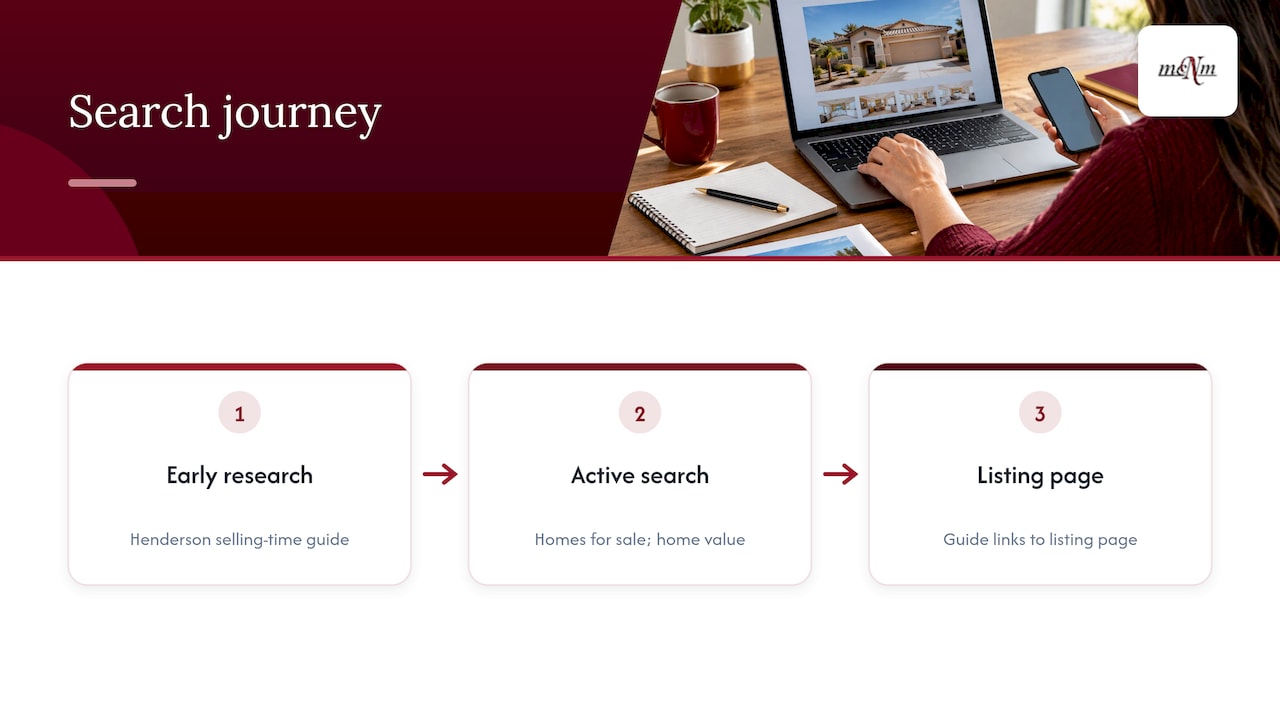
Buyers and sellers move through stages. Early on, they read guides such as “best time to sell a home in Henderson.” Later, they search for “Henderson homes for sale” or “what is my home worth.” Build content for each stage. A guide can catch the early reader and link to a listing page for the one who is ready.
Pick keywords with a place in them
A simple routine for each neighborhood you serve:
- List the neighborhoods where you have listings or want them.
- Search each in Google and note what shows up in the suggestions and “People also ask” box.
- Skip broad terms like “real estate.” Big national sites own them. Aim for terms such as “[neighborhood] homes for sale” or “[city] real estate agent.”
- Use the phrase naturally in the title, headline and first paragraph. Do not stuff it in.
Search Engine Land suggests running neighborhood terms through a keyword tool and filtering for lower difficulty and buying intent. Lower difficulty means fewer strong sites compete for the term.
Local SEO for real estate in Southern California and Arizona
The steps are the same across states. What changes is the detail that makes your pages real.
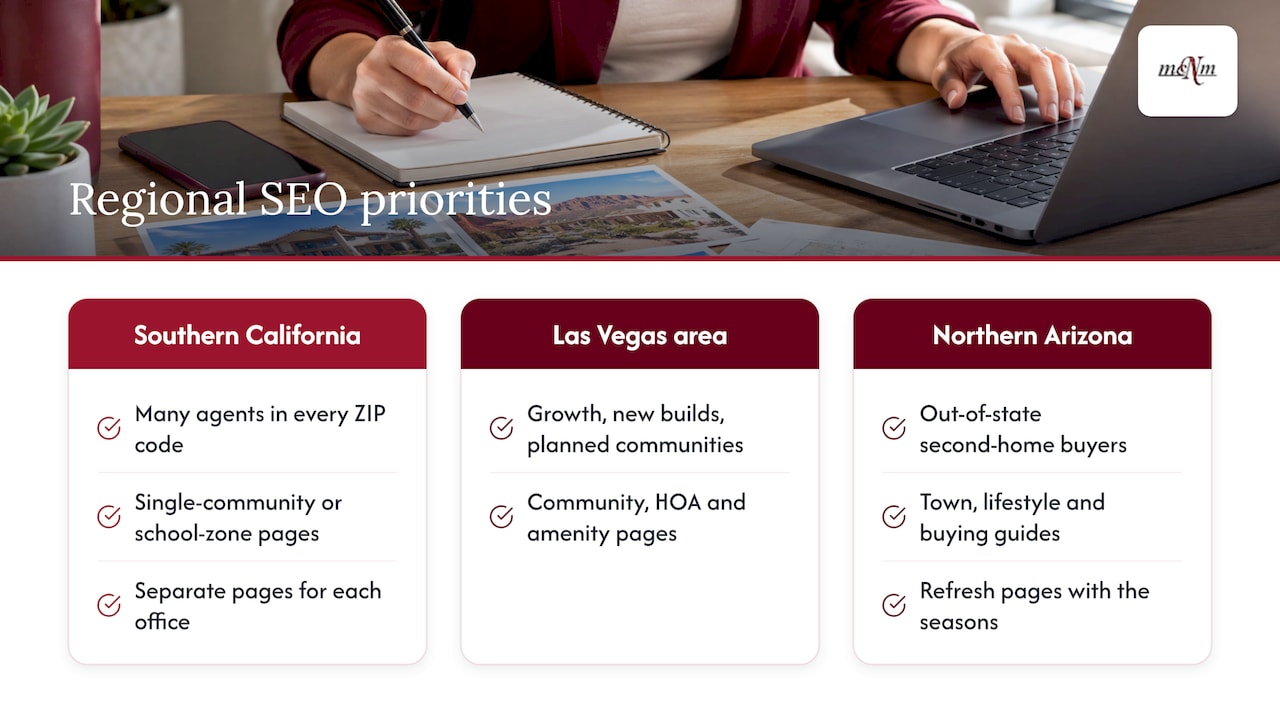
Southern California. Markets such as Los Angeles, Orange County, San Diego and the Inland Empire have many agents in every zip code. Winning usually means going small: a page for a single community, a single school zone or a single type of buyer. If your team covers several offices, each office needs its own profile and its own page. Our multi-location local SEO work in Southern California is built for that.
Las Vegas, Henderson and North Las Vegas. Growth areas, new builds and master-planned communities create steady search demand. Pages about specific communities, HOAs and nearby amenities speak to those searches. Our Las Vegas Google Maps playbook explains how local ranking works in this market.
Flagstaff, Sedona and Prescott. Many buyers here are second-home or relocation buyers who search from out of state. Content about the town, the seasons, the lifestyle and the buying process helps them long before they call. Because demand moves with the seasons, keep your profile photos, posts and pages fresh as the year turns.
Reviews and consistent business details
Reviews are part of prominence. Google lists review count and ratings as signals. They also help a stranger decide to call you.
Here is a simple review routine:
- Ask at closing, when the client is happiest.
- Send a short text or email with a direct link to your Google review page.
- Follow up once if they have not replied.
- Reply to every review, good or bad, in a calm and helpful tone.
- Keep in touch after the sale so the client remembers you well.
An example script:
“Congratulations on your new home! If you have two minutes, a Google review would help other families in Henderson find an agent they can trust. Here is the link.”
Do not offer gifts in exchange for reviews, and do not review-gate, which means only asking happy clients. Ask everyone. If you want help running this every month, our Review Generation Engine is $397 per month.
Next, check your NAP: name, address and phone number. They should match on your website, your profile and the main directories. A different suite number or an old phone number on one site makes your business look less certain to Google. Fix the major ones first, then the smaller ones.
Website basics that help local searches
Most buyers and sellers search on a phone. If your site is slow or hard to use there, they leave. Cover these basics:
- Speed and mobile layout: pages should load fast and read well on a small screen. Buttons and phone numbers must be easy to tap.
- Clean structure: a page for each key neighborhood, linked from a menu or an area page, so visitors and Google can find them.
- Image care: use real photos with clear file names and short descriptions. Compress them so pages stay quick.
- Clear calls to action: a phone number, a home search and a home value form on every important page.
- Secure, maintained site: keep your WordPress site updated. Our WordPress Website Care Plan is $197 per month.
A slow, outdated site undermines good local work. A fast one makes every click count.
Follow up fast, or the lead goes elsewhere
Ranking gets the call. Following up wins the client. A buyer who calls three agents will often work with the one who answers first. If you are showing a home and miss a call, a missed call can be a missed commission.
Set up a way to answer every inquiry quickly: a text-back to missed calls, a form that alerts you right away, or an after-hours assistant. Our free Missed Call Calculator helps you see what missed calls may cost your business. We also offer marketing automation and CRM setup and AI agents that answer leads around the clock.
Measure what matters
Rankings alone do not pay the bills. Track the things that turn into clients:
- Calls from your profile. Google shows call and direction counts in your Business Profile.
- Search visits. Google Search Console, a free tool, shows which searches bring people to your site and which pages they land on.
- Form fills. Count home value requests and contact forms.
- Lead quality. Note how many leads became consultations and signed agreements.
- Source. Ask every new client how they found you and write it down.
Review the numbers once a month. If a neighborhood page gets visits but no leads, change its call to action. If a page gets no visits, check whether the title matches what people search.
Tactics to avoid
- Fake reviews or paid review swaps.
- Dozens of near-identical city pages.
- A fake office address, or a virtual office you do not use.
- Stuffing the same phrase into every sentence.
- Buying cheap links in bulk.
These can cost you your profile or your rankings, and the damage is slow to undo.
How to start this month
If you do only a few things, do these in order:
- Confirm your Business Profile qualifies and is complete.
- Fix your name, address and phone number everywhere.
- Start asking every client for a review.
- Write one strong page for your best neighborhood.
- Set up call and lead tracking.
Curious where you stand? Run our free Local SEO Checkup to see how visible your business is today.
Perspective: why local real estate SEO rewards patience and proof
We build marketing around data from Search Console, calls and conversions, and we judge it by leads and revenue, not vanity numbers. For real estate, that means one thing: the agent who shows real local knowledge wins.
Most agents we meet want to rank for the whole city. We would rather see you own one neighborhood first, with a complete profile, honest reviews and a page that tells a buyer something they cannot get from a national portal. Then repeat it, community by community.
That is also why we publish our prices. Local SEO starts at $997 per month, because steady work on your profile, pages and reviews is what moves a local ranking. We are a Las Vegas team serving Southern Nevada, Southern California and Northern Arizona, and we want you to know what you are buying before you call.
Michael O. Franklin Jr.
Get help with local SEO for real estate
You can do much of this yourself, but it takes steady weekly effort, and every hour you spend on it is an hour you are not with clients. We handle the work for you. Our Local SEO Starter plan is $997 per month, and our Growth SEO & Content plan is $1,997 per month. Both are listed on our pricing page. Our local SEO work covers Google Business Profile management, reviews, citations and city pages built to win the Map Pack.

Every engagement starts with a free marketing audit. Book yours, or call (702) 608-4226 and tell us which neighborhoods you want to own.
FAQ
Can a real estate agent have a Google Business Profile?
Often yes, if you meet customers in person during stated hours. Google says sales or leasing offices are eligible, while properties for sale and lead-generation agents or companies are not. Read the eligibility rules before you set up or edit a profile.
How long does local SEO for real estate take?
It depends on your market and how many agents compete in it. Profile fixes can help sooner, while pages and reviews build over months. Neighborhood pages with less competition often move faster than whole-city terms. We do not promise a ranking date, but we can show you where you stand in a free audit.
How many neighborhood pages should I build?
Start with the three to five areas where you want the most business. Make each page useful and different, with local data and photos. Add more as you see results. Many thin pages are worse than a few strong ones.
Do reviews really matter for ranking?
Yes. Google lists review count and ratings among the signals of prominence. Reviews also help a buyer or seller choose you. Ask every client, and reply to each review.
Sources
- Real estate SEO guide, Search Engine Land
- Business eligibility and ownership guidelines, Google Business Profile Help
- Tips to improve your local ranking on Google, Google Business Profile Help
Leave a Reply