

You run a Christian business by deciding what it is for, writing that down, and letting that purpose shape every price, hire and customer promise. Then you make sure customers can find you, so the business can keep serving them.
That sounds simple. In a busy week of estimates, payroll and missed calls, it is not. This guide walks through the principles Christian business writers return to most, and turns each into a routine you can use this month. It is written for owners of local service businesses in Las Vegas, Henderson, Southern California and Northern Arizona, and for anyone leading several locations.
TL;DR
- Start with a written purpose and a few guardrails, such as honest pricing, fair pay and no unnecessary debt.
- Treat profit as a means to serve customers, employees and your community, not the only goal.
- Share your faith when it fits the moment and when people are comfortable. Never pressure staff or customers.
- Keep honest books and plan cash flow so you can pay people on time.
- Do the work of being found. A business nobody can find cannot serve anyone.
Table of Contents
- What a Christian business actually is
- Principle 1: Write down your purpose and guardrails
- Principle 2: Treat profit as a tool, not the goal
- Principle 3: Price honestly
- Principle 4: Lead employees with fairness and care
- Principle 5: Do the right thing when it costs you
- Principle 6: Share your faith without pressure
- Principle 7: Be a careful steward of money
- Principle 8: Make sure the people you serve can find you
- A 30-day plan to put this into practice
- How MCNM helps you be found
- Our view: faith shows up in the ordinary work
- FAQ
- Sources
What a Christian business actually is
A Christian business is not defined by a fish symbol on the truck or a verse on the website. It is defined by the policies that govern day-to-day decisions. Crown Financial Ministries makes this point in its piece on defining a Christian business: the rules you follow each day show whether the business is being used to serve God.
The same ministry describes owners as stewards. A steward runs something that belongs to someone else. In practice, Crown’s guidance for small businesses says every decision, from hiring to firing to paying to promoting, should be made in harmony with Scripture, with excellence and integrity.
That gives you a useful test. For any decision, ask: would I be comfortable explaining this to the customer, the employee and God?
Principle 1: Write down your purpose and guardrails
The US Christian Chamber of Commerce summarizes the advice from Becca Spradlin’s book Lead On Mission in four moves: define the higher purpose and guardrails, protect it through policies, ownership and governance, champion it through culture and succession planning, and abide in daily rhythms of prayer and Christian community.
Here is a simple way to start:
- Write one sentence on why the business exists beyond income. For a roofer in Henderson it might be: “We protect families’ homes and tell them the truth about what the roof needs.”
- List three to five guardrails. Examples: we never upsell work a customer does not need, we pay vendors on time, we never run fake “limited time” offers.
- Put the guardrails in your employee handbook and your estimate process, not only on the wall.
- Review them each quarter with your leadership team.
A purpose that lives only in your head disappears the first time cash gets tight. A purpose in your policies survives bad months.
Principle 2: Treat profit as a tool, not the goal
Some owners feel guilty about making money. Others chase it at any cost. Scripture-based business writing avoids both.
Theology of Work’s chapter on love of God versus the pursuit of profit says profit is legitimate as pay for risk and opportunity cost. It also quotes Jim Collins and Jerry Porras, who call profit a necessary condition for existence and a means to more important ends. The authors conclude that a Christian view neither minimizes profit nor raises it above everything else.
Larry Burkett’s Business By the Book, reprinted by Harris College’s Center for Christianity in Business, names four long-term goals: fund the gospel, meet needs, be a disciple, and make a profit. Notice that profit sits on the list. A business that loses money cannot give, hire or serve for long.
A practical habit: set a giving percentage and a profit target at the same time, in the same budget meeting. Both are plans, not afterthoughts.
Principle 3: Price honestly
Pricing is where values meet the customer first. Provia Global’s guide on Christian business principles says pricing should be explainable without embarrassment: no hidden charges, deceptive discounts, misleading quantities, false scarcity, or taking advantage of a customer who knows less than you. It ties this to Proverbs 16:11 on honest scales.
For a service business, that turns into a checklist:
- Give written estimates that list what is included.
- Explain add-on charges before the work starts, not on the invoice.
- Skip countdown timers and “only two slots left” claims unless they are true.
- When a customer does not need the premium option, say so.
This matters in tourism towns too. In Sedona or on the Las Vegas Strip corridor, many of your customers are visitors who will never see you again. Honest pricing is the only reputation they can judge in a single visit.
Crown’s list of minimums for a God-dedicated business includes being absolutely honest, providing a quality product at a fair price, and treating all people fairly. Pricing is where all three show up at once.
Principle 4: Lead employees with fairness and care
Biblical leadership in business starts with how you treat the people who work for you.
Burkett’s guide asks employers to consider whether they would be willing and able to live on the wages they pay, and points to James 5:4 if the answer is no. Meeting the needs of employees and their families is one of the four goals it lists.
Provia adds two practical points drawn from Colossians 4:1. Paying someone late because you failed to plan cash flow affects a whole household, and workers should have a reasonable way to raise concerns without fear. Authority is never permission to humiliate.
Try these routines:
- Pay on schedule, every time. Keep a cash reserve sized to cover payroll before you cover anything optional.
- Hold a short monthly one-on-one with each direct report. Ask what is getting in their way.
- Create a private channel for concerns, such as a form or a named manager outside the person’s own chain.
- Hire on three checks. LifeWay’s Thom Rainer, as reported by The Gospel Coalition, looks at character, competency and chemistry, and admits his weak spot is competency: hiring people he likes without confirming they can do the work. Test skills as carefully as you test fit.
Brad Larson of Suntech Building Systems, quoted in the same article, says leadership skills are about the leader’s heart more than tactics. He describes his own default mode as selfish and sinful, so he stays in Scripture and counsel to protect the people in his care from himself. Owners at any size can borrow that humility.
Principle 5: Do the right thing when it costs you
Every owner hits a moment where honesty is expensive. A crew damages a customer’s tile. A bid was too low. A supplier offers a cheaper part with questionable sourcing.
Larson’s core value, as reported by The Gospel Coalition, is to do the right thing no matter what it costs. In construction, he says, that can mean paying for someone else’s mistake, or admitting a mistake even when it might cost you the customer.
Provia makes a related point: a Christian entrepreneur may decide that the most profitable option is not the most faithful one, such as a lucrative contract that is ethically questionable.
Decide in advance, in writing, what you will do in these cases. A rule set on a calm Tuesday is easier to keep than one invented during a dispute.
Principle 6: Share your faith without pressure
Many owners ask how open to be about their faith. Theology of Work lists five appropriate times, based on 1 Peter 3:15: when it grows out of authentic relationships, fits the conversation naturally, coworkers are comfortable, you are asked, and it does not take time from paid work. It adds that you should never press a spiritual discussion when listeners become uncomfortable.
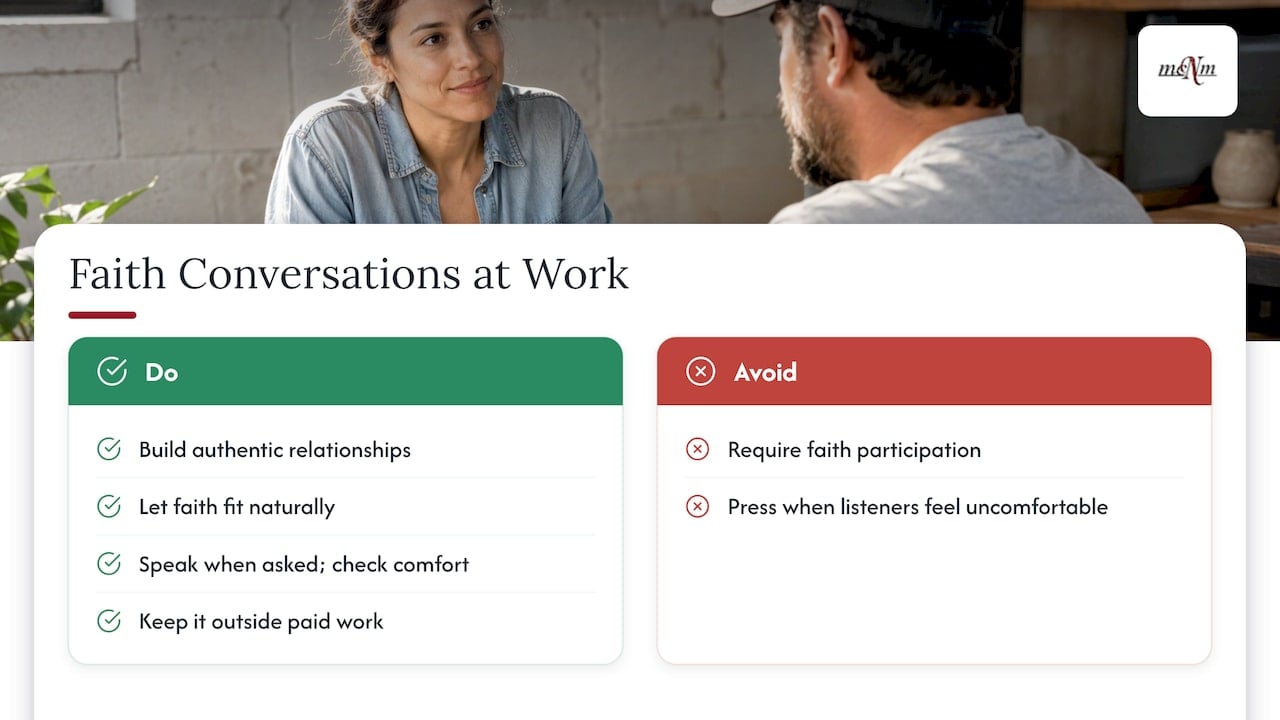
One owner interviewed on the Faith Driven Entrepreneurs podcast says Bible studies at his company are not mandatory and employees do not have to be Christian to work there. If someone of another religion wants a room for their own study, the company provides it.
On the legal side, the Christian Entrepreneurs Association notes that US protections for faith in business include the Religious Freedom Restoration Act, the ministerial exception and Title VII, but cautions that these protections are not automatic and must be asserted. Employment law differs by state and by the size of your team. Before you add a prayer meeting, a faith statement in your hiring materials or any religious requirement, talk with an employment attorney in your state.
A safe baseline: invite, never require. Keep customer conversations about their needs, and let your work and honesty carry most of the witness.
Principle 7: Be a careful steward of money
Stewardship shows up in your books. Provia says good records are not spiritually neutral administration, because they help a leader tell the truth about the business. It also urges caution about debt: borrowing that exposes the business or family to unreasonable risk should not be justified just because growth looks attractive. Crown’s list of minimums likewise includes avoiding unnecessary debt and honoring creditors.
A simple stewardship routine:
- Close your books monthly, not once a year at tax time.
- Track cash weekly, especially if you are seasonal. A Flagstaff or Sedona tourism business needs a plan for the slow months before they arrive.
- Borrow only for something with a clear payback, and know what you would do if revenue dipped.
- Review your giving and your marketing spend in the same meeting, so neither is squeezed by accident.
If your business gives a portion of profit to ministry, think ahead about succession. A Christian Economic Forum whitepaper on business-as-ministry argues that a sale to a private equity firm or industry buyer can end that giving, so owners should plan their exit early.
Principle 8: Make sure the people you serve can find you
This is the principle owners skip. If your purpose is to serve customers well, the business has to be visible when they search. A plumber who answers honestly but ranks nowhere on Google never gets the chance.
For a local service business, that means a complete Google Business Profile, a steady flow of real reviews, a fast mobile website, and a plan for answering every call and message. Those are practical, honest ways to be found, and they fit every guardrail above. Never fake reviews or buy them. Ask real customers after real jobs.
Two free tools help you see where you stand:
- The free Local SEO Checkup shows how visible your business is in local search.
- The free Missed Call Calculator estimates what unanswered calls may be costing you.
If you want the longer case for search, read our piece on why small businesses use SEO to grow.
A 30-day plan to put this into practice
| Week | Focus | What you finish |
|---|---|---|
| 1 | Purpose | One-sentence purpose and three to five guardrails, written down |
| 2 | Pricing and people | Estimate template with included items listed, pay-on-time cash reserve target |
| 3 | Money | Monthly close routine, debt review, giving and profit plan |
| 4 | Visibility | Google Business Profile review, review request routine, missed-call check |
Do not try to finish everything at once. One guardrail you actually keep beats ten you only wrote.
How MCNM helps you be found
MCNM Marketing is a Las Vegas agency founded in 2016 by Michael O. Franklin Jr. We help service businesses across Southern Nevada, Southern California and Northern Arizona get found on Google and turn searches into calls and booked jobs. Our prices are published, and every engagement starts with a free marketing audit.

If you want a clear starting point, our Local SEO Starter is $997 per month, and the one-off Google Business Profile Sprint is $997. Our Google Ads management is a flat $1,497 per month plus ad spend. You can see every plan on our pricing page, or explore our website design and SEO services. To begin, book the free marketing audit or call (702) 608-4226.
Our view: faith shows up in the ordinary work
We have built websites since 2004, and we started MCNM in 2016 on a simple idea: a business that serves people well should be easy to find.
We see the same pattern with Christian owners. They care deeply about honesty, fair pay and serving their city, but they treat marketing as a distraction from that mission. We think it is part of the mission. If a family in Henderson needs an honest electrician tonight, they will call the first good option they find.
That is why we build every plan on Search Console, call and conversion data and judge it by leads, calls and revenue, not vanity numbers. It is also why we publish our prices. Honest pricing is a principle we ask our clients to follow, so we follow it too.
Start with your purpose and guardrails. Then let us help you make sure the people you want to serve can reach you, and that someone answers when they do.
Michael O. Franklin Jr.
FAQ
What does the Bible say about starting a business?
The sources above treat work as a calling and business as a way to serve. The Gospel Coalition’s Africa Study Bible article says God created humans to work, and that business is a calling that must earn a profit to survive while serving others first. It points to Jesus’ model of service in Matthew 20:26-28. Talk with your pastor or a trusted mentor for guidance on your own situation.
What are the core Christian business principles?
Most lists agree on a few: honesty, fair pricing, fair pay, careful use of debt, giving, and respect for every person. Crown Financial lists eleven minimums, including providing a quality product at a fair price and generating a profit. Pick the few that matter most for your trade and write them into your policies.
How do I lead biblically without pushing faith on employees?
Lead by example and invite rather than require. Offer optional studies, treat every person fairly regardless of belief, and follow the five appropriate times to share your faith from Theology of Work. Check your state’s employment rules with an employment attorney first.
Do I need to market a Christian business differently?
The tools are the same: a strong Google Business Profile, real reviews, a fast website and quick follow-up. What differs is the standard you hold yourself to, which means honest claims and real reviews only. Our free marketing audit shows where your business stands today.
Sources
- Crown Financial Ministries: God’s Principles for a Small Business
- Crown Financial Ministries: Defining a Christian Business
- US Christian Chamber of Commerce: Faith Forward Businesses
- Theology of Work: Love of God vs. the Pursuit of Profit
- Harris College Center for Christianity in Business: Biblical Business Goals
- Provia Global: 10 Christian Business Principles
- The Gospel Coalition: How to Discern God’s Will in Your Workplace
- Theology of Work: Five Appropriate Times to Share Your Faith at Work
- Christian Entrepreneurs Association: Faith & Business Leadership
- Faith Driven Entrepreneurs podcast: Building a Christ-Centered Company
- Christian Economic Forum: Sustaining Business as a Ministry in Perpetuity
- The Gospel Coalition Africa: How To Be a Christian in Business
Leave a Reply