

Generative engine optimization (GEO) is the work of making your business easy for AI tools to find, understand and mention in their answers. For a local service business, it starts with strong SEO, a complete Google Business Profile and clear pages that answer real customer questions.
That is good news. You do not need a new playbook. You need the right foundations, in the right order, and a way to check whether they work. This guide shows how that looks for a Henderson plumber, a Los Angeles dentist or a Sedona tour company.
TL;DR
- GEO means earning mentions and citations inside AI answers from tools like ChatGPT search, Google AI Overviews and Google AI Mode.
- Google says optimizing for its AI features is still SEO, so crawlable, helpful, well-organized pages come first.
- To appear in ChatGPT search, let OpenAI’s search crawler reach your site. To appear in AI Overviews, make sure your pages are indexed and eligible for a snippet.
- Keep your Google Business Profile complete and your reviews fresh. Local answers lean on that data.
- Track results in Search Console’s generative AI reports, and test your own visibility with our free Local SEO Checkup.
Table of Contents
- What generative engine optimization means for a local business
- GEO vs. SEO: one foundation, two scoreboards
- How AI search picks sources
- Which AI tools matter to your business
- How to show up in Google AI Overviews
- How to rank in ChatGPT search
- Write content AI systems can use
- Your Google Business Profile is part of GEO
- Measure whether GEO is working
- GEO for Las Vegas, Southern California and Arizona businesses
- Common GEO mistakes
- Where our AI Search Visibility Sprint fits
- Our perspective on GEO
- FAQ
- Sources
What generative engine optimization means for a local business
A generative engine is a search tool that writes an answer instead of only listing links. ChatGPT search, Google AI Overviews and Google AI Mode all do this. They read many web pages, then summarize what they found.
GEO is the practice of making your brand and content easy for those systems to find, understand and reference. Search Engine Land describes it as building on the same SEO fundamentals, with the focus moving from rankings and clicks to how your brand is mentioned and cited inside AI answers.
You may also see the terms AEO (answer engine optimization) or “AI search optimization.” Google Search Central treats them as the same goal: better visibility in AI search experiences.
Why should a plumber in North Las Vegas care? Because customers now ask full questions. “Who fixes a broken AC compressor in Henderson on a Sunday?” is a typical one. An AI tool may answer with two or three business names. GEO is how you earn one of those spots.
GEO vs. SEO: one foundation, two scoreboards
Here is the simple way to see it.
| Traditional SEO | GEO | |
|---|---|---|
| Where you appear | A ranked list of links, the Map Pack | Inside an AI-written answer |
| What you win | A click or a call | A mention, a citation, a recommendation |
| How you measure it | Rankings, traffic, calls | Citations, mentions, share of voice |
| Foundation | Crawlable, helpful pages, strong profile | The same |
The measures in the table come from the Search Engine Land overview. The last row is the key. Google’s own guidance says that, from its perspective, optimizing for generative AI search is still SEO. Its AI features are rooted in core Search ranking and quality systems.
That means every dollar you put into solid local SEO also builds your base for AI search. It also means the order matters. Fix the foundation, then add the AI-specific steps.
How AI search picks sources
Google’s guide explains two ideas worth knowing in plain terms.
- Grounding. The AI looks up real web pages before it writes, so its answer rests on sources instead of memory alone.
- Query fan-out. One question becomes several smaller searches behind the scenes. “Best roofer in Prescott Valley for tile roofs” may split into searches on roofers, tile roofing and local reviews.
What does this mean for you? Your site needs to answer the small questions, not only the big one. A roofer with a page on tile repair, a page on storm damage and a clear service area is easier to match than one with a single “Services” page.
Which AI tools matter to your business
Three surfaces cover most of what your customers see.
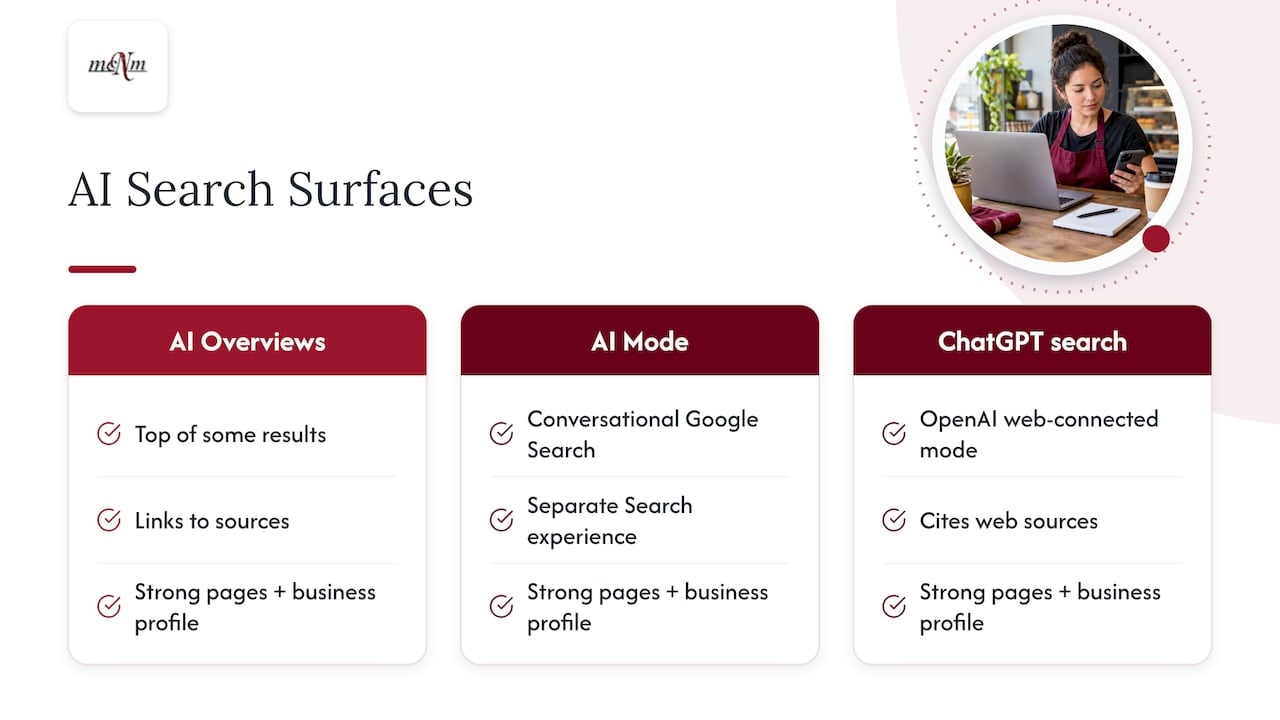
Google AI Overviews. Google announced AI Overviews at I/O in May 2024, starting with everyone in the U.S. They sit at the top of some search results with links to sources.
Google AI Mode. This is a separate, conversational part of Google Search. It became available in the U.S. without a Labs signup on May 20, 2025, according to Google’s announcement.
ChatGPT search. This is OpenAI’s web-connected mode. It cites web sources in its answers.
You do not need a separate strategy for each. The same strong pages and profile feed all three. The technical steps differ a little, and the next two sections cover them.
How to show up in Google AI Overviews
Google’s AI features documentation is direct. There are no extra requirements or special tricks. A page must be indexed and eligible to appear in Google Search with a snippet.
The same page also says you do not need new machine-readable files, AI text files or special schema.org markup. It tells businesses to keep Merchant Center and Business Profile information up to date.
So your checklist is short:
- Make sure Google can index your pages. Check Search Console for pages marked “not indexed.”
- Keep snippets allowed. Do not block them with page settings.
- Keep your Business Profile current. Hours, address, categories and services should match your website.
- Write pages worth quoting. More on that below.
Google also notes that AI Overviews appear only when its systems judge them additive to classic Search, and they often do not trigger. It says it has observed that clicks from results pages with AI Overviews are higher quality, with users more likely to spend more time on the site. A visitor who arrives from an AI answer has often done more research before calling you.
How to rank in ChatGPT search
OpenAI publishes how its crawlers work. Its bot documentation says to allow OAI-SearchBot in your robots.txt file and to allow requests from its published IP ranges.
Two details matter:
- Sites that opt out of OAI-SearchBot will not be shown in ChatGPT search answers. They can still appear as navigational links.
- OAI-SearchBot is separate from GPTBot, OpenAI’s training crawler. You can set rules for each one. Changes to robots.txt take about 24 hours to take effect.
A robots.txt file is a small text file at the root of your website that tells crawlers where they may go. Many WordPress security plugins and hosting firewalls block unknown bots by default. If your site blocks them, no content improvement will help.
This is a good first check. Ask whoever manages your website whether OAI-SearchBot can reach it. If you work with us, our WordPress Website Care Plan is $197 per month and keeps the technical side of your site maintained.
Write content AI systems can use
Google’s AI optimization guide lists what helps. Most of it is plain good practice:
- Make content crawlable and reachable through internal links.
- Put important information in text, not only in images or video.
- Organize pages with clear headings and sections.
- Add high-quality images and video.
- Use semantic HTML where possible, follow JavaScript SEO best practices and reduce duplicate content.
- Create non-commodity, people-first content with a unique point of view.
“Non-commodity” means content a competitor cannot copy by rewording a summary. For a local business, that is where you have the edge. You know things no national site knows.
What local, first-hand content looks like
Here are examples of the kind of page we mean. They are illustrations, not client results.
- A Las Vegas pool service explains why summer evaporation and hard Las Vegas Valley water change its chemical routine, with photos from real jobs.
- A Henderson HVAC company lists the steps of a spring tune-up, what each costs and how long each takes.
- A San Diego dental office answers insurance questions patients ask at the front desk.
- A Sedona tour company explains which trails suit which season and what to bring.
- A Flagstaff snow-removal business explains its service zones and response times by neighborhood.
Each example answers a real question with detail only that business has. That is what an AI tool wants to cite.
Do not mass-produce pages
Google warns that creating separate content for every query variation to manipulate AI responses violates its scaled content abuse spam policy. Write one strong page per real service and city you serve. Do not spin out hundreds of near-copies.
Your Google Business Profile is part of GEO
For local questions, AI answers lean on local data. Google Business Profile Help says local results are based mainly on relevance, distance and prominence. Prominence reflects how well known your business is. That includes links, articles, directories, review count and review score.
Google advises keeping your business information complete and accurate, including address, hours, category and attributes. It also advises responding to reviews.
Put that into a weekly routine:
- Check that hours and phone number match your website.
- Add new photos of real jobs.
- Ask every happy customer for a review.
- Reply to every new review, good or bad, within a few days.
- Post an update about a current service or offer.
Our Google Business Profile optimization checklist walks through each field, and our guide to Google Business Profile posts shows what to post. If you want it done for you, our Google Business Profile Sprint is a $997 one-off.
Measure whether GEO is working
You cannot manage what you cannot see. Two tools help.
Search Console. Google’s Search generative AI performance reports show impressions, pages, countries, devices and dates for generative AI features in Search and Discover. Google announced them on June 3, 2026 and rolled them out to all websites worldwide by August 31, 2026. Data is available at hourly, daily, weekly and monthly levels.
Your own phone. Calls and form fills are the real score. Track which ones start from Google, from AI tools and from your profile. Ask new customers how they found you, and write it down.
You can also ask ChatGPT and Google the same questions your customers ask, such as “best electrician in Summerlin” or “who does kitchen remodels in Orange County.” Note which businesses appear. Repeat monthly. Your free Local SEO Checkup gives you a quick view of how visible your business is in local search today.
GEO for Las Vegas, Southern California and Arizona businesses
The basics are the same everywhere, but the local picture is not.
Las Vegas, Henderson and North Las Vegas. Many people search for emergency and same-day services in a hot climate. Short, clear answers on response times, service areas and pricing ranges help here. Name your neighborhoods: Summerlin, Anthem, Green Valley, Centennial Hills.
Southern California. Competition is heavy in Los Angeles, Orange County, San Diego and the Inland Empire. Separate pages for each city you truly serve, with unique local detail, beat one generic page. Keep your profile data identical across every listing.
Flagstaff, Sedona and Prescott. Tourism and seasonal demand drive searches. Tourists ask AI tools for plans and recommendations before they arrive. Keep seasonal hours and offers current on your profile and your site.
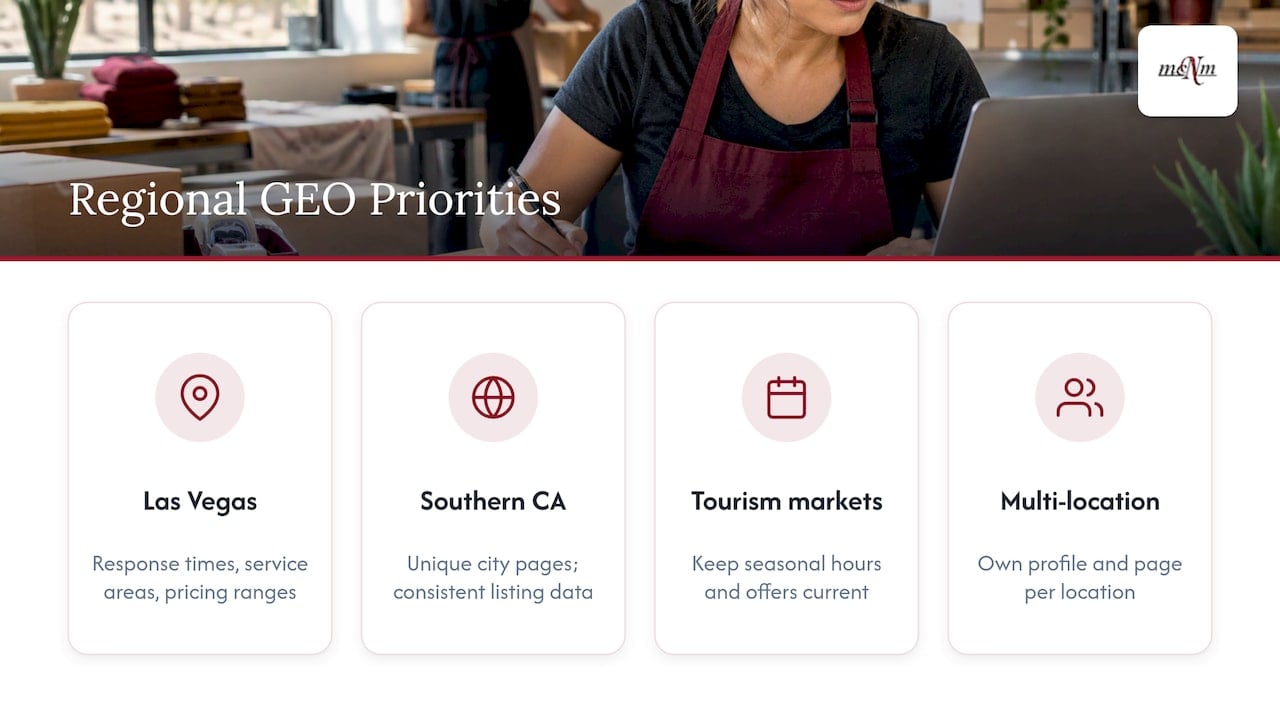
Multi-location brands and franchises. Each location needs its own accurate profile and its own local page. Consistency across 5 or 50 locations is the hard part. Our enterprise SEO services are built for multi-location and franchise systems.
Common GEO mistakes
- Blocking crawlers by accident. A security setting can shut out OAI-SearchBot or Googlebot.
- Hiding key facts in images. A price list saved as a picture cannot be read as text.
- Letting profile data go stale. Wrong hours or an old phone number hurt trust with customers and with AI tools.
- Chasing tricks. Google says no special files or markup are needed for AI Overviews.
- Publishing thin city pages. Copy-and-paste pages with only the city name changed add little.
- Ignoring reviews. Review count and score feed prominence.
Where our AI Search Visibility Sprint fits
If you would rather have a team handle this, we built the AI Search Visibility Sprint. It is a $1,497 one-off with a published price. Our work is built on Search Console, call and conversion data and judged by leads, calls and revenue.
If you want ongoing support, our Local SEO Starter plan is $997 per month, and Growth SEO & Content is $1,997 per month. Every price is on our pricing page. Every engagement starts with a free marketing audit.

Want to see where you stand first? Book a free marketing audit or call (702) 608-4226.
Our perspective on GEO
We have built websites since 2004, and the pattern holds: tools change, and customers still choose businesses they can find and trust.
That is why we do not treat GEO as a separate magic trick. Google’s own guidance ties its AI features to core Search ranking and quality systems. When we build a plan, we start with the same things: a fast, mobile-first WordPress site, clear service pages, a complete Google Business Profile and a steady flow of real reviews.
Then we add the AI layer. We check that AI crawlers can reach your site, that your pages answer the small questions behind each big one, and that your business facts match everywhere they appear. We judge the work by calls, booked jobs and revenue, not by vanity numbers.
Business owners tell us they feel behind on AI. You are not. The owner who keeps the profile current, answers customers well and publishes honest local content is already doing most of GEO. Our job is to close the gaps and show you the numbers.
Michael O. Franklin Jr.
FAQ
Is generative engine optimization different from SEO?
It has a different goal, but the same base. SEO aims for rankings and clicks. GEO aims for mentions and citations in AI answers. Google says optimizing for its generative AI search is still SEO, so strong SEO is your starting point.
How do I get my business into ChatGPT answers?
Allow OAI-SearchBot in your robots.txt file so ChatGPT search can reach your site. Then publish clear, helpful pages and keep your business details consistent online. OpenAI says robots.txt changes take about 24 hours to take effect.
Do I need special markup or an AI text file for AI Overviews?
No. Google says there are no extra requirements for AI Overviews or AI Mode. Your page must be indexed and eligible to show in Google Search with a snippet. Keep your Business Profile information current as well.
How can I tell if my business shows up in AI answers?
Use the generative AI reports in Search Console for Google’s features. Also ask AI tools the questions your customers ask, and record the results each month. Most important, track your calls and ask new customers how they found you.
How long does GEO take?
There is no fixed timeline, and no one can promise a result. Technical fixes like crawler access can take effect within a day. Content and review growth build over months. A free marketing audit shows which fixes to make first.
Sources
- Generative Engine Optimization (GEO): What It Is & How to Do It, Search Engine Land
- Google’s Guide to Optimizing for Generative AI Features on Search, Google Search Central
- AI Features and Your Website, Google Search Central
- Overview of OpenAI Crawlers, OpenAI
- Introducing Search Generative AI performance reports, Google Search Central
- How to improve your local ranking on Google, Google Business Profile Help
- Google I/O 2024 keynote, Google
- AI in Search: from information to intelligence, Google
Leave a Reply