

Google Ads has no fixed price. You set a budget, and you pay each time someone clicks your ad, which in the US has recently run about $4.33 per click at the median. Most local service businesses start between $20 and $50 a day, and the right number depends on what a customer is worth to you.
This guide shows how Google charges you, what clicks cost, how to turn those numbers into a budget, and what a management fee adds on top.
TL;DR
- Search ads are pay-per-click. You set an average daily budget, and Google caps your monthly spend at 30.4 times that amount.
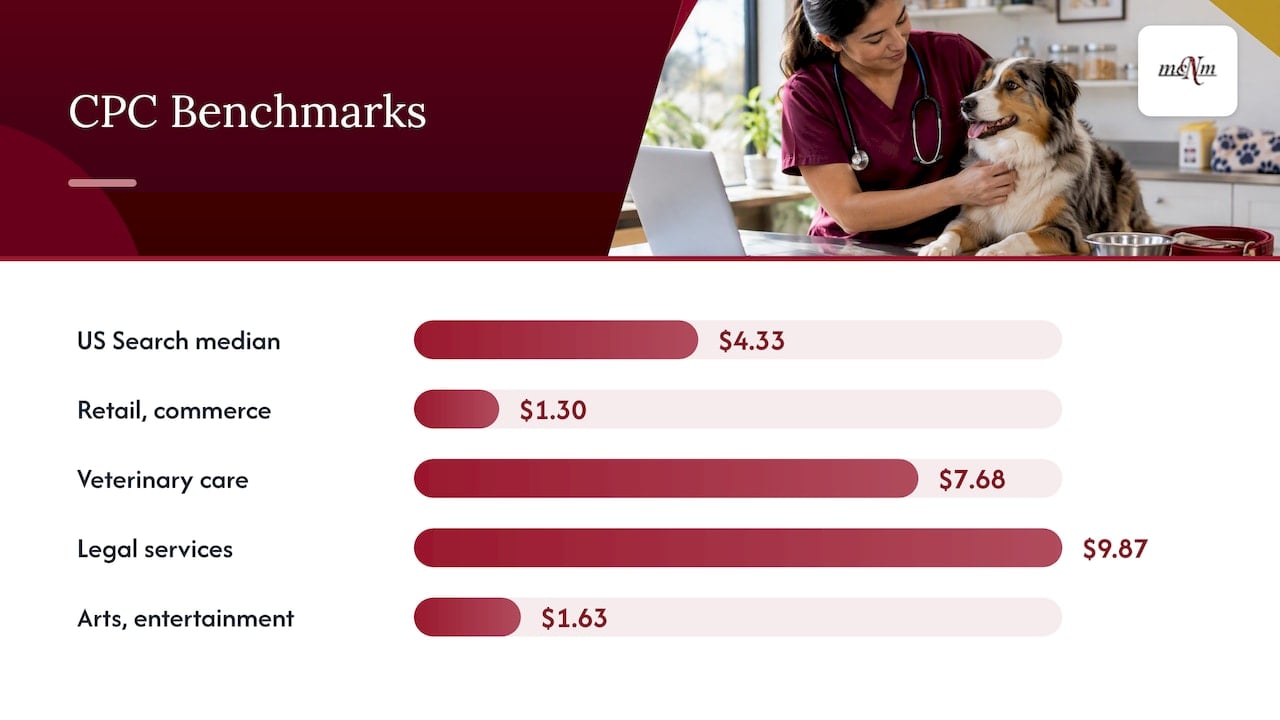
- The median US Search CPC is about $4.33, but it ranges from about $1.30 in retail to $7.68 in veterinary care, and higher in legal.
- Judge Google Ads by cost per lead, not cost per click. The average US cost per lead was $70.11 in 2025.
- A small local budget of $500 a month can work for a narrow service, but it buys only about 115 clicks at average prices.
- Management fees are separate from ad spend. Ours is a flat $1,497 a month, with no markup on your spend.
Table of Contents
- How Google Ads charges you
- What clicks cost in 2026
- Cost per lead matters more than cost per click
- Is $20 a day, $100 or $500 a month enough?
- Google Ads cost in Las Vegas and other Southwest markets
- What drives your costs up (and how to bring them down)
- Agency management fees: the second cost
- Our view: budget for customers, not clicks
- See what your Google Ads budget should be
- FAQ
- Sources
How Google Ads charges you
Google Search ads run on a cost-per-click model. You pay only when someone clicks. Showing up in results costs nothing.
That is the first cost point to understand. If 1,000 people see your ad and nobody clicks, you pay $0. If 10 people click, you pay for 10 clicks.
How the auction sets the price
Every search triggers a quick auction. You do not necessarily pay your maximum bid. In the auction, advertisers pay just enough to beat the advertiser below them, which is why the same keyword can cost different amounts on different days.
Three things move your price:
- Competition. More businesses bidding on “AC repair” in Las Vegas in July means higher clicks costs than a quiet month.
- Your Quality Score. This is Google’s rating of how relevant your ad, keyword and landing page are. A CPC more than 50% above the industry average can point to a low Quality Score or keywords that are too broad.
- Your bidding setup. Bid too low and you may not show. Bid too broadly and you pay for clicks you do not want.
Daily and monthly budgets
You set an average daily budget. Google may spend up to twice that on a busy day, but it will not exceed your monthly limit. For most campaigns, monthly spend is capped at 30.4 times your daily budget.
So a $20 daily budget means up to about $608 in a month. Some days you spend $9, some days $38. Google optimizes spending toward days when people are more likely to click and convert, so costs follow demand.
If you run several campaigns, you can use shared budgets to spread spending across them.
What clicks cost in 2026
The average depends on who measured it and which industries they included. Here is what recent studies show:
| Measure | Figure | Source |
|---|---|---|
| Median US Search CPC | $4.33 | Adkit, September 2026 |
| Median CPC, all industries (Google and Microsoft Ads) | $5.26 | AdsPreview |
| Lowest US industry median (retail and commerce) | $1.30 | Adkit |
| Highest US industry median (veterinary care) | $7.68 | Adkit |
| Attorneys and legal services | $9.87 | Search Engine Journal |
| Arts and entertainment | $1.63 | Search Engine Journal |
Do not treat any one number as your price. Comparing averages across industries can mislead, because costs differ greatly between a plumber in Phoenix and a lawyer in New York. Your own keywords, city and season set your real cost.
Campaign type matters too. Search campaigns cost more per click than Display or Performance Max, because many people on those placements were not actively searching. For a service business, that higher price often buys better intent. Someone searching “water heater repair Henderson” wants a plumber now.
Cost per lead matters more than cost per click
Clicks are not the goal. Calls and booked jobs are. Cost per lead is often more useful than cost per click for judging a campaign.
For reference, the average US cost per lead for Google Ads was $70.11 in 2025, and the average conversion rate was 8.18%.
Here is how that math works. Use it with your own numbers:
Cost per lead = cost per click ÷ conversion rate
At a $4.33 click and an 8.18% conversion rate, that is about $53 per lead. At a $9 click and a 5% rate, it is $180 per lead. A $180 lead is a bad deal for a $150 service call. It is a great deal for a $12,000 roof replacement.
So the real question is: what is a new customer worth to you?
Is $20 a day, $100 or $500 a month enough?
These are the questions people ask most. The honest answer is that it depends on your click price and how many leads you need. These examples use the averages above, so treat them as illustrations, not promises.
Is $20 a day good for Google Ads?
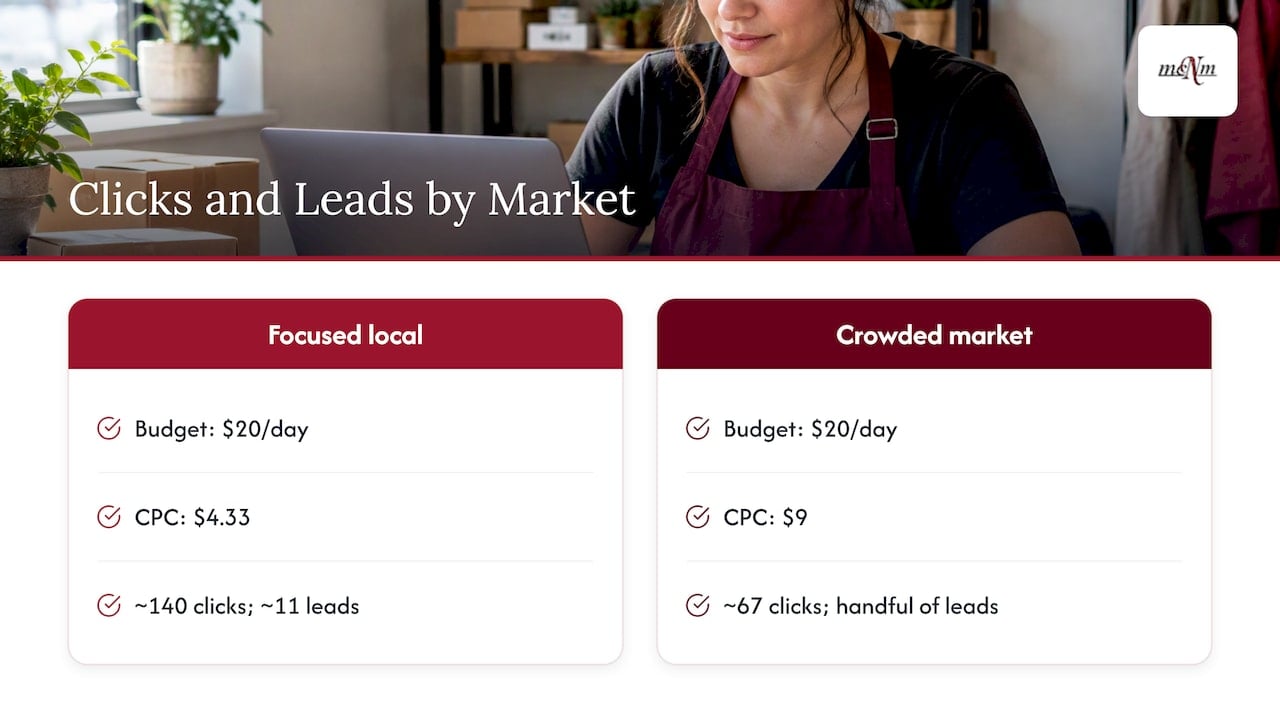
$20 a day is about $608 a month. At a $4.33 click, that is roughly 140 clicks. At an 8.18% conversion rate, that is about 11 leads. For a narrow local service with a few focused keywords, that is a workable test. For a crowded market with $9 clicks, you get about 67 clicks and a handful of leads.
Is $500 a month enough?
At $4.33 a click, $500 buys about 115 clicks, or about 9 leads at the average conversion rate. That can work for a small business in a smaller market, such as a Prescott electrician serving one area. It leaves little room for mistakes, though. Keep the keyword list tight and the service area small.
Is $100 enough?
A one-time $100 buys about 23 clicks at the median. That might produce one or two leads. It is enough to learn which searches bring calls, but not enough to judge a campaign. Treat it as a test, not a strategy.
A simple way to set your own budget
- Know your average job value. Use profit, not just revenue.
- Set a target cost per customer. Many owners aim to spend no more than 20% to 30% of the first job’s profit. Pick a ratio you can afford.
- Estimate your close rate. If you book 1 in 3 leads, a $70 lead costs about $210 per customer.
- Work backward to leads. Want 15 new customers a month? At a 1-in-3 close rate, you need 45 leads.
- Multiply by your cost per lead. 45 leads at $70 is about $3,150 a month in ad spend.
- Divide by 30.4 to get your average daily budget. In this example, that is about $104 a day.
- Start lower, then scale. Begin at 50% to 70% of that number, watch actual cost per lead for 30 days, then raise the budget on what works.
If the target number is far above what you can spend, narrow the goal. Run ads for your most profitable service only, or in your best two zip codes.
Google Ads cost in Las Vegas and other Southwest markets
Location changes the price. A few patterns we see across the markets we serve:
- Las Vegas and Henderson. Heat-driven services like AC repair, pool service and pest control get busier in summer, and more advertisers bid. Plan for higher costs when demand peaks.
- Los Angeles, Orange County and San Diego. Larger populations mean more searches, but also more bidders. Focus on specific cities and service terms instead of broad ones.
- Flagstaff, Sedona and Prescott. Tourism and seasonal businesses swing with visitor traffic. Raise budgets for peak weeks, and lower them when demand drops.
These are patterns, not published price lists. Google’s own cost estimator gives budget benchmarks by industry and location, and it is a good first check before you commit.
If you want to see where your business shows up today, run our free Local SEO Checkup. Ads and local search work best together.
What drives your costs up (and how to bring them down)
Most wasted ad spend comes from a short list of mistakes:
- Broad keywords. “Plumber” attracts job seekers and DIY readers. “Emergency plumber Henderson NV” attracts buyers.
- No negative keywords. Block terms like “free,” “jobs” and “how to” so you do not pay for clicks that never turn into customers.
- A weak landing page. A slow page that does not match the ad lowers your Quality Score and your conversion rate. Both raise cost per lead.
- No call tracking. If you cannot tell which clicks became calls, you cannot cut the bad ones.
- Missed calls. Paying $60 for a call that goes to voicemail is the most expensive mistake of all. Use our free Missed Call Calculator to see what unanswered calls cost you each month.
Two more checks help. If your CPC is far above the industry average, look at your Quality Score and keyword match types. If your CPC is low but your click-through rate is also low, your bids may not be competitive enough. A higher-than-average CPC is fine if the return justifies it.
Agency management fees: the second cost
Ad spend goes to Google. A management fee goes to whoever runs the account. They are separate bills, and you should ask for both numbers up front.
You have three common options: run the account yourself and pay with your time, hire a freelancer, or hire an agency. Fees vary a lot by provider, so compare what each includes: setup, call tracking, reporting and who owns the account.
We keep ours simple. Our Google Ads management is a flat $1,497 a month plus your ad spend. We do not mark up your spend, and you own the ad account. Our Full-Funnel Growth plan is $3,497 a month plus ad spend, for businesses that want ads, SEO and follow-up working together.
The flat fee matters for one reason. A fee based on a percent of spend rewards an agency when you spend more, not when you get more customers. A flat fee removes that conflict.
Our view: budget for customers, not clicks
We run Google Ads like an operator, not a vendor. Every plan we build starts with Search Console, call and conversion data, and we judge it by leads, calls and revenue.
Here is what we have learned from working with service businesses across Southern Nevada, Southern California and Northern Arizona. The owners who get the best return do not ask “What is the cheapest click?” They ask “What does a booked job cost me?” Then they set a budget that supports that number, track every call, and answer every lead fast.
That last part is where money leaks. A good campaign can still fail if the phone rings out. That is why we pair ads with missed-call text-back and AI agents that reply to every lead around the clock, with a handoff to your team.
Start small. Prove the cost per lead. Then scale the budget on numbers you trust, not on a guess.
— Michael O. Franklin Jr.
See what your Google Ads budget should be
We publish our prices, and every engagement starts with a free marketing audit. We look at your market, your competition, your current ads and your tracking, then give you a realistic budget range and an expected cost per lead before you spend anything with us.
You can book your free marketing audit online or call us at (702) 608-4226. If you want to see all plans first, our pricing page lists every package and fee.
FAQ
How much does Google Ads cost per month for a small business?
There is no set price. Small businesses commonly spend from a few hundred dollars to several thousand dollars a month on ad spend, depending on market and goals. Set your budget from your cost per lead and the number of customers you want, not from a general average.
Do I pay if nobody clicks my ad?
No. Google Search ads charge per click, so you pay only when someone clicks. If your ad shows 1,000 times and gets no clicks, the cost is $0. Your monthly spend also cannot go over the limit set by your daily budget.
Is it worth paying for Google Ads?
It can be, when you track results and the numbers work. At the US average cost per lead of $70.11, ads pay off if a customer is worth meaningfully more than that after your close rate. Ads work best for services where people search when they need help, like repair, cleaning and legal help.
Why is my cost per click so high?
Usual causes are heavy competition, a low Quality Score, broad keywords or a landing page that does not match the ad. If your CPC is more than 50% above your industry average, audit those four things first.
Does a management fee count toward my ad budget?
No. Management fees pay the person or team running your account. Your ad budget goes to Google. At MCNM, the fee is a flat $1,497 a month, and all of your ad spend goes to ads.
Sources
- How much does Google Ads cost? (Google Ads)
- About average daily budgets (Google Ads Help)
- Budgets overview (Google Ads Help)
- Choose your bid and budget (Google Ads Help)
- How Much Do Google Ads Cost in 2026? (Adkit)
- Google Ads Cost Per Click by Industry 2026 (AdsPreview)
- What Are Good Google Ads Benchmarks In 2026? (Search Engine Journal)
- Google Ads costs keep rising, but conversion rates improved in 2025 (Search Engine Land)
Leave a Reply