
Reply to a negative review fast, stay calm, thank the customer, own what is true, and move the conversation offline. If the review is fake or breaks Google’s rules, report it instead of arguing with it.
That is the short version. Below you get the full process, word-for-word scripts, and the legal lines you should not cross. It is written for service owners in Las Vegas, Henderson, Southern California and Northern Arizona, where one bad review can sit above your next customer’s search.
TL;DR
- Reply to every negative review, ideally within one to two business days, and keep it short and polite.
- Thank the reviewer, acknowledge the problem, state one fact if needed, and offer a phone number or email.
- Never argue, never reveal customer details, and never threaten the reviewer.
- Report a review only if it breaks Google’s content policies. Disagreement is not a policy violation.
- Do not buy reviews or hide bad ones. A federal rule now bans that and allows civil penalties.
Table of Contents
- Why your reply matters more than the review
- Responding to negative reviews in Las Vegas, Henderson and beyond
- The 6-step reply process
- Scripts you can adapt
- What not to do
- How to report a fake or policy-breaking review
- The legal line: what the FTC rule says
- Perspective: what we see in the field
- Build a review base so one bad review hurts less
- A simple weekly routine
- Common mistakes
- How MCNM can help
- FAQ
- Next step
- Sources
Why your reply matters more than the review
A negative review is read once by the person who wrote it. Your reply is read by every future customer who scrolls past it.
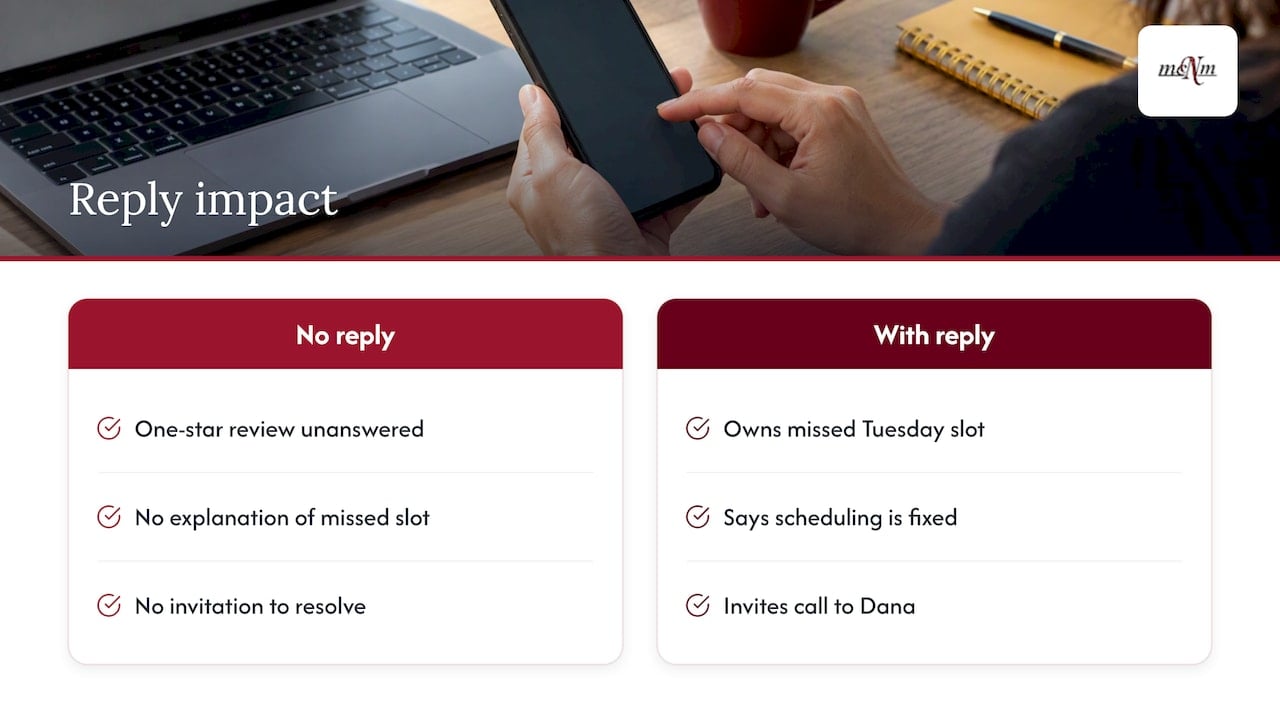
Think of two pool cleaners in Henderson. Both have a one-star review about a missed appointment. One has no reply. The other says, “You’re right, we missed your Tuesday slot. We’ve fixed our scheduling. Please call Dana at the office so we can make it right.” Most people hire the second one.
Google says that when you reply, you show customers you value their feedback. You must verify your Business Profile before you can reply. If you have not done that yet, do it first.
One more point. A survey write-up from SmartSurvey suggests you aim to respond to every review, and put priority on negative reviews with specific complaints and mixed reviews where a good response could change perception.
Responding to negative reviews in Las Vegas, Henderson and beyond
Local service work makes reviews personal. An AC tech in North Las Vegas in July, a plumber in Orange County, a Sedona tour operator in peak season: each one gets judged on a few stars and a few lines.
The steps below work in any of those markets. The only thing that changes is the detail you put in, such as the day, the job type or the team member who will call.
The 6-step reply process
Step 1: Pause before you type
Read the review twice. Wait an hour if it stings. Replies written in anger are the ones that get screenshotted.
Step 2: Check if it is a real customer
Look up the name, date and job in your records. This tells you which path to take:
- Real customer, real problem: reply and fix it.
- Real customer, facts are wrong: reply with the correct facts, calmly.
- No record of this person, or the review is clearly spam or abuse: report it to Google, and consider a short public reply too.
Step 3: Thank them and acknowledge the issue
Open with thanks and name the problem in plain words. “Thanks for telling us about the late arrival” works better than “We apologize for any inconvenience.” People can tell when you are using a stock line.
Step 4: Own what is yours, state facts if needed
If you made a mistake, say so in one sentence. If the facts are off, give the correct version once and stop. Do not repeat the false claim in your reply. Do not tell your side in four paragraphs.
Step 5: Offer a next step offline
Give a name, a phone number or an email. This shows other readers you act on complaints. It also keeps details about the job off a public page.
Step 6: Follow up and log it
When the issue is solved, note what went wrong. If three reviews in a row mention late arrivals, you have a process problem, not a reputation problem. Fixing it protects your ratings better than any reply.
Scripts you can adapt
Change the details so each reply sounds like your business. Do not paste the same text under every review.
When the complaint is true
Hi Marcus, thank you for the honest feedback. Our crew arrived two hours after the window we gave you, and that is not our standard. We have changed how we confirm arrival times. Please call me directly at [number] so I can make this right. — Jenna, Owner
When the facts are wrong
Hi Sam, thanks for taking the time to write. Our records show the service was completed on March 3 and the quote was $[amount] before work began. We want you to be happy with the result, so please call [number] and we will review it together.
When the customer is angry and vague
Hi Alex, we’re sorry your visit did not go well. We’d like to understand what happened. Please email [address] or call [number] and ask for the manager.
When you cannot find the customer
We could not find a job under this name in our records. If you worked with us under a different name, please call [number] so we can look into it.
When the review is a one-star with no text
Thank you for the rating. We’d like to hear what we could do better. Please contact us at [number].
Notice the pattern: short, human, specific, and with a way to reach a real person.
What not to do
- Do not argue. Even if you win the point, you lose the audience.
- Do not share private details. Names, addresses and job specifics do not belong in a public reply.
- Do not offer money in public for a changed review. Fix the problem first. Let the customer decide what to do after that.
- Do not threaten. More on that in the legal section below.
- Do not copy and paste one reply everywhere. It reads as automated.
- Do not ignore it. No reply tells readers you don’t care.
How to report a fake or policy-breaking review
Many owners search for how to remove fake Google reviews. Here is the honest answer: you can only get a review removed if it breaks Google’s rules.
Google’s help page says you can report a review that violates Google policies. It also notes that Google does not settle disputes between you and a customer. Disliking the tone or disagreeing with the story is not enough.
Google’s prohibited and restricted content policy says reviews should reflect a genuine experience at a place or business. Things that usually qualify for a report include:
- Spam or fake reviews, including ones from people who never used your service
- Reviews from a competitor or a former employee posing as a customer
- Profanity, hate or threats
- Reviews about a different business
Here is a workable routine:
- Open your Business Profile and find the review.
- Choose the report option and pick the policy it breaks.
- Save a screenshot and your job records that show there is no matching customer.
- Check the status in Google’s review management tool.
- If Google declines, look at Google’s appeal options for content decisions.
Be realistic. A first decision is often final, so report only reviews that truly break a rule. While you wait, post a calm public reply. If the review is removed, nothing is lost. If it stays, your reply is already working for you.
The legal line: what the FTC rule says
Since late 2024, a federal rule covers fake and suppressed reviews. The FTC announced a final rule banning fake reviews and testimonials that bars buying or selling them and lets the agency seek civil penalties against knowing violators.
For a small business, three practical points follow:
- Do not write or buy reviews. The rule text at 16 CFR 465.2 makes writing, creating or selling a fake consumer review an unfair or deceptive act.
- Do not threaten reviewers. The FTC release says the rule also covers using legal or physical threats or intimidation to stop a negative review.
- Do not show only the good ones. Hiding negative feedback on your own site to misrepresent your overall rating can be a violation as well.
The FTC’s questions and answers page is the plain-language guide. It also says the rule does not ban incentives for reviews, as long as the incentive does not depend on the review being positive. If a lawyer’s input is needed on a specific situation, such as a customer you plan to send a legal demand to, talk to a licensed attorney in your state before you act.
Perspective: what we see in the field
We are a Las Vegas agency, and we have helped service businesses with Google Business Profiles since 2016. Here is what we tell owners.
First, the reply is a sales page. You are writing for the next customer, not for the angry one. Second, the best defense is volume. A steady flow of honest reviews from happy customers makes one bad review a small part of the picture. Third, treat every complaint as data. If you see the same problem twice, fix the process.
We also see owners rush to report every bad review. Most of those reports fail, because the review is real. Save your energy for the replies and for earning new reviews.
We judge our own work the way we judge client work: by calls, leads and revenue, not by vanity numbers. Reputation is part of that. A good reply can be the reason a caller picks up the phone.
— Michael O. Franklin Jr.
Build a review base so one bad review hurts less
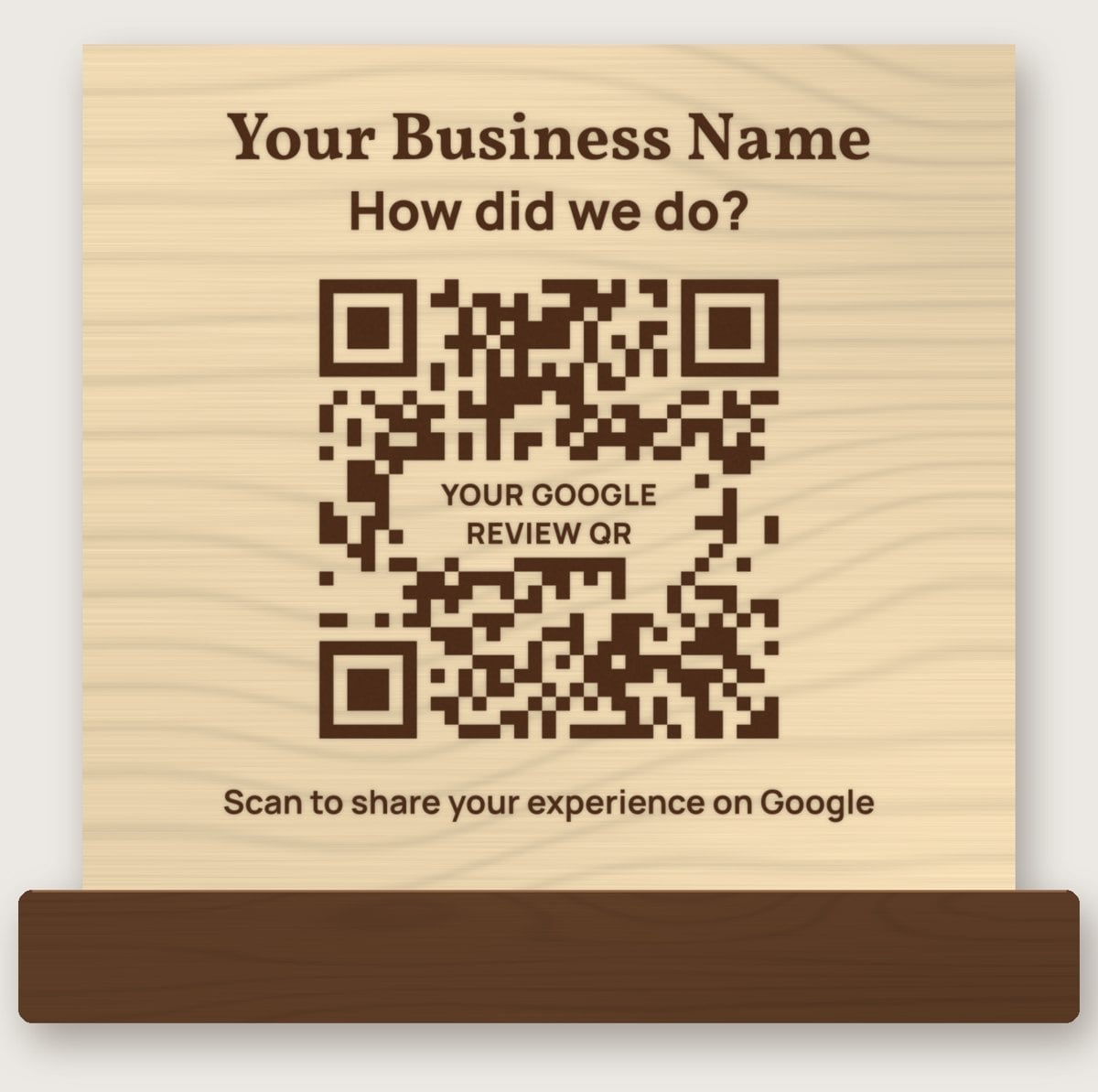
The cleanest answer to negative reviews is more real positive ones. Ask every happy customer, right after the job, with a direct link. Our guide on getting more Google reviews in 15 minutes a week gives you a simple routine. If you work at events, shops or front desks, a custom Google review stand puts a QR code in the customer’s hand.
Do not gate your requests by sending only happy customers to Google. That is the review gating trick, and it misleads readers. Ask everyone.
Finish the basics too. A complete profile with fresh photos, correct hours and services makes you look active. Use our Google Business Profile optimization checklist to find the gaps. To see how your business shows up today, run the free Local SEO Checkup.
A simple weekly routine
You do not need a big team. Set aside 15 minutes each week:
- Open your Google Business Profile and read new reviews.
- Reply to every negative or mixed review first.
- Reply to the positive ones with one personal line each.
- Log any repeated complaint and assign someone to fix it.
- Send review requests to the last week’s happy customers.
Do this in the same slot each week, such as Monday morning before the first job. A habit beats a rush after a bad week.
Common mistakes
- Replying only to bad reviews. It looks defensive. Answer the good ones too.
- Waiting weeks. The longer it sits, the more readers see an unanswered complaint.
- Writing for the reviewer, not the audience. Keep it short and calm for the strangers reading it.
- Using the same script every time. Add the job type, the date or a name.
- Reporting everything. Only report what breaks a policy.
How MCNM can help
If you do not have time to watch reviews and ask for new ones, we can run it for you. Our Review Generation Engine is $397 per month. Our content and reputation management team can also help you set up reply standards. See every published price on our pricing page.
Not sure where to start? Book a free marketing audit and we will look at your profile, your reviews and your local rankings.
FAQ
How fast should I respond to a negative review?
Aim for one to two business days. Faster is better, since new readers see an open complaint. If you need time to check records, post a short holding reply and follow up by phone.
Should I respond to a fake review?
Yes, in most cases. Report it to Google first if it breaks a policy. Then post a calm reply saying you cannot find the customer in your records and invite them to call. Readers see that you are fair, even if the review stays.
Can I get a bad Google review removed because I disagree with it?
No. Google does not settle disputes between businesses and customers. A review comes down only if it violates Google’s content policies, such as spam, fake content or a conflict of interest. For a real but unfair review, the best tool is a polite, factual reply.
Can I ask a customer to take down their review?
You can contact them to solve the problem, and they may update the review on their own. Do not pay them for a change, and never threaten them. The FTC’s 2024 rule prohibits threats or intimidation aimed at suppressing negative reviews.
Next step
Want a second pair of eyes on your reviews and local rankings? Request your free marketing audit at mcnmmarketing.com or call us at (702) 608-4226.
Sources
- Manage customer reviews, Google Business Profile Help
- Report inappropriate reviews, Google Business Profile Help
- Prohibited and restricted content, Google Business Profile Help
- Appeal Business Profile content and profile restrictions, Google Business Profile Help
- FTC announces final rule banning fake reviews and testimonials
- 16 CFR 465.2, eCFR
- The Consumer Reviews and Testimonials Rule: Questions and Answers, FTC
- The feedback blind spot, SmartSurvey
Leave a Reply